
How To Extend Your Vocabulary and Memorize More Words With Swearing

How To Extend Your Vocabulary and Memorize More Words With Swearing

I know, I know. The mere word “cursing” causes knee-jerking of all of those pure at heart. And that’s why I have to warn you before you move further into the text.

The article contains quite a bit of profanities/obscenities/vulgarisms/expletives. So to say it briefly – it’s not for the faint-hearted.

But to be clear – I have no intention of shocking anyone. But I do believe that cursing might be a VERY useful tool for memory improvement if used the right way. So approach everything you’re about to read with the open mind.

Ok, you have been warned.

Swearing Facts


Let’s start with the fun fact. Do you know that “fuck” and “shit” are among the 75 most often spoken words in American English? That’s right. Obscene language seems to be an inseparable and indispensable part of every language (Foote & Woodward, 1973).

Not shockingly, according to the Association for Psychological Science, an average person in United Stated utters about 80-90 swear words per day. It amounts to even 3,4 % of all the words used daily.
That’s why it’s hard to achieve full fluency without knowing at least a couple of swear words.

What’s amazing, in almost every country, there are individuals who have taken it to the extreme.
They seem to communicate only with help of swear words and grunting! But let’s treat them as a separate case.

Memorize More Words – Original Approach To Swearing


As an anecdote, I can tell you about my good friend from Russia (and an amazing polyglot). He has a very interesting approach to vulgarities of all kinds. Every time when he wants to start learning some language or get the taste of it, he starts with swear words.

If I’m not mistaken, currently he can swear in over 20 languages. He might not be able to quote Shakespeare in Greek but he surely can tell you to “go f**k yourself” in this language.

Once, he taught me to swear in Russian to such a degree that my conversational partner at the time was blushing like a nun at a dildo exhibition! What a great guy!

Anyway, that goes without saying that obscene language is avoided and treated as a taboo.
It’s nowhere to be found as a part of any language learning curriculum. Even though it is an important element of everyday speech.

Although, it’s hard to blame anyone for this state of affairs. Probably not that many people would be willing to attend the school where they would have to repeat after teacher “f*ck you!”.

So it seems that dirty language is doomed to stay in the shadows of every language learning curriculum.
But that’s good news. The forbidden fruit always grabs your attention.

Why?

Because such a language is characterized by EXTREMELY intense emotions. And exactly these emotions can help you to memorize new vocabulary much faster than before.

But first, let’s take a look at advantages of learning such a language.

Why You Should Learn How To Swear In Your Target Language


1) So you don’t make silly (and inappropriate) mistakes.

The line between saying the word you intend to say and the one you really utter might be very thin.

My colleague at my previous, corporate work had to present some data in front of our English supervisors. She tried to be very professional and business-like. But she couldn’t understand why the managers were chuckling all the time.

Of course, not ALL the time. It only happened when she was saying the word “account”. Or at least she thought that she was saying it. In fact, what managers could hear was “a c*nt”.

Believe me, they were very composed considering the fact that every 2 min my colleague was saying something along the lines – “a c*nt of one of the customers had to be closed/opened/verified”.

2) It facilitates communication (Black et al., 1985; Hall, Nagy, & Linn,1984).

Think about it. It would be weird if every time you bumped your toe against the cupboard, you said “oh, it hurts, and I’m so angry right now!” instead of hearty “that motherf*cker!”.

Intense feelings can be expressed and emphasized much more effectively with help of swearing.

How many times have you met a native speaker of some other language and asked him to teach you some cuss words?

What’s more, it’s also funny for the native speaker. Hearing somebody saying curse words with a funny accent in their native tongue can be really hilarious!

3) It deepens the comprehension of the language, the culture, and the people.

Once you understand why they say the things they say, the language becomes much clearer. Read more about benefits of language learning here.

4) It can improve your memory

Such a language carries a huge emotional load. And I will show you how you can use it to boost your memory.

How Swearing Works In The Brain

But before I share some of the techniques I use, let me explain why swearing can be a powerful learning tool.

Neuroscientists from Weill Medical College of Cornell University found that the amygdala, which is responsible for processing emotion and memory, was highly active when exposed to swear words.

What’s important for us, the amygdala is also connected to the memory function part of the brain.

The bad news is that the repetition decreases its activity. The more you swear, the less active this part is. That’s why some people never seem to be bothered by such a language!

How To Use Swearing In Language Learning


Below, you can find three techniques which I use quite frequently.

Learn swear words and dirty expressions from your target language

I know – duh. But I rush to explain why.
Many cuss words and dirty expressions contain every-day words. Once you realize this, you’ll be able to fish them out and memorize them almost instantaneously.

I’ll give you just one example so you get a general idea since I feel weird enough writing this article!

Imagine that you just started learning English and you come across the following phrase – “go f*ck yourself”. Once somebody explains its meaning to you, it’ll be hard to forget it. And besides the omnipresent “f*ck” you learn another useful word “go”.

If you are wondering, where you can learn some frequently used curse words in your target language, read on.

Translate swear words / dirty expressions from your native tongue into your target language

You already know them. You are also aware of the emotions which are associated with them.
Of course, most of the time such translations won’t make much sense. However, that’s beside the point. This technique is only meant to help you learn new words with bigger ease.

Example:

“I will tear you a new a**hole” translated into any language will almost certainly sound absurd. But you will learn how to say “tear” in your target language!

Get creative and abuse your virtual opponent

This technique allows you to vent and learn at the same time! Imagine the person you dislike/hate/ despise sitting right in front of you. How would you abuse him/her in a creative way? You don’t even need to use a very vulgar language!

Monty Python serves as a great example.

“I fart in your general direction. Your mother was a hamster!”. You get the idea.

Basically, you can take any two words from your target language and try to turn them into a creative insult.

Write the short story in your target language

Think about some unpleasant situation and try to write a short story about. Throw in an obscene word and spicy comparisons every now and then.

“The night was dark as a truckload of a**holes when I …”.

Useful Websites


There are only two websites worth recommending
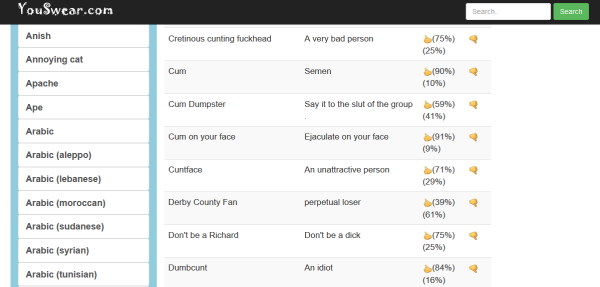
www.youswear.com/

How To Extend Your Vocabulary and Memorize More Words With Swearing

The best website of this kind which you will find. It contains swear words from dozens upon dozens of languages. What’s more, it also has a voting system to make sure that the listed swear words are in use.

They even have “a word of the day” if you needed more reasons to visit this website!

www.insults.net/html/swear/

Memorize More Words With Swearing

Not as good as the previous website but you still might find it useful. It contains swear words from over 40 languages. The number of obscene expressions is usually quite small but their translations are very reliable.

Be Careful With Swearing


Finally, as a word of caution – don’t try to use swear words in your target language without consulting them with native speakers.

As language learners, we usually lack a significant part of the emotional programming necessary to feel the emotion behind the words, how they affect others, and the proper context to use them.

We weren’t conditioned from a very young age to feel their emotional effect. And that’s why better tread lightly my friend. And good luck!


Accelerate Your Language Learning Thanks To A Great Strategy You Can Learn From Body Builders

Accelerate Your Language Learning

I would like to start this article with a hymn of praise for languages. Oh, how beautiful they are. Their sweet melody. Their hypnotizing rhythm. The ear-caressing flow of perfectly arranged words.

Ok. Joking aside. I’d like to pause again for a moment, just to think why learning a language resembles residing in one of the hell’s circles. You see, Dante was wrong. His vision did include only 9 circles.
There is actually the tenth one. It’s designed for beginners in language learning.

To successfully have a chat in a foreign language, you have to achieve so-called communicative competence. Sounds sexy, I know. But even without reading about it, you know that communicating in a language is damn demanding.

The simplified list of requirements looks like this. You need to quickly recall needed words (between 1k and 2k minimum). You need to know how to pronounce them (Phonology). You need to know where to put them in a sentence (Syntax). You need to know how they change (Morphology).

You need to when to use them depending on circumstances (Pragmatics). At the same time, you need quite a high level of comprehension to understand your interlocutor.

What’s more, if you happen to talk to somebody attractive of the opposite sex, you must remember to:

  • keep it cool
  • block excessive sweating
  • be at least remotely funny

And then there is a phase after each conversation when you have to swallow sadness, pick up the pieces of your self-confidence and convince yourself that language-learning journey IS exciting.

That sucks. We’ve all been there at one point or another. And the progress. Don’t get me started on this one. It’s excruciatingly slow in most cases.

Why?

Let’s take a look at the typical (unorganized) language journey.

Typical Effects Of Learning After A Few Years


Just a short notice – I didn’t make this up. These are actual words of one of my students.

“I can talk quite ok when it comes to vocabulary, listening, and pronunciation. I understand many things which I hear on the radio and TV. However, I make tons of mistakes in conversation and can only use a few tenses.”

That’s a bit shortened version. But it should give you some foretaste of the frustration. And all due to the typical classroom teaching language philosophy.

I, The Teacher, Will Correct The Cr*p Out Of Everything You Say


The common language-teaching philosophy is to correct or try to correct almost every mistake. That’s the way one-way ticket to becoming a mayor of the Looney Town.

Just try to imagine that you learn English (unless you really do!) and you say something along these lines – “Tim want to become doctor.”

Your tutor looks at you. His face slowly changes. And then the shitstorm ensues.

“First of all, you don’t say want, but wantS. Also, you always should remember that In English, an indefinite article is needed in front of professions. What’s more, you need to work on your pronunciation! You don’t pronounce x and y the right way…. “. And so on.

The chance is that after one lesson of this kind, you don’t remember most of these remarks. How could you? You can’t concentrate equally on talking and processing all the mistakes. Also, you probably haven’t uttered more than 30-40 sentences during one hour. The constant interruptions are not very helpful. At this pace, you’ll become fully conversant in about, well, 3-4 years?

I believe there is a better way to learn and to teach. The body-building champions can give us a great point of reference.

How Body Builders Train

“It all starts with body-part splits. The researchers were surprised to discover that every single one of these bodybuilders used body-part split-routines either five or six days a week. Every. Single. One. Not most of them or almost all of them, but every single one.”

(You can find the original article here)

A small explanation for those of us (including me) who keep their distance from gyms. Body-parts split mean that body-builders train a certain part of the body on a certain day.

You can imitate this process by conducting grammar and vocabulary drills.

Grammar and Vocabulary Grammar Drills


The main purpose of doing such grills is to concentrate on one thing and one thing only.
For a limited period of time, you practice just this one part of a language.

It means ignoring (as much as possible) all the other mistakes you make. If you decide to work on some future tense – so be it. Ignore the rest.

You can use this technique to activate and practise your vocabulary at the same time.
Simply prepare the list of, say, 20 words which you would like to practise and include it in your grammar drills.

Where Should You Start?


That’s always a very good question. But the answer is relatively simple. You should always choose the part of grammar which is essential for communication and the one that you are the worst at.

Personally, I recommend doing such drills 6 times per week. No, you can’t unwind on the seventh day. On the seventh day, you should put all the pieces together and actually have a conversation with someone. Unless, of course, you have a conversational partner handy. In this case, talk as much as possible.

Benefits


If you have done it before, I don’t have to convince you. For all the non-believers:

Secondly, to be a tad more mature, the said method allows you to significantly decrease the cognition burden on your working memory. You simply can’t process, analyze and correct all the mistakes you make. This method allows you to eliminate mistakes one by one.

It helps you join together and strengthen the elements that you already know, and build toward a higher level. It is like the big jigsaw puzzle when you can start plugging the missing pieces into the picture more and more quickly.

Language teachers can also use it. Instead of correcting all kinds of mistakes of your students, concentrate on one or two of them. Such approach will accelerate your students’ progress rate.

Results


I’ve experienced it for the first time with my German. I was doing drill after drill. And I felt like my progress wasn’t that great. And suddenly one day BOOM! Magic happened. Language fairy sprinkled some magic dust all over me and I started speaking with such confidence that I felt as if somebody else was speaking.

And I wish you the same! Let the language fairy be with you!

How to Deal With Overwhelm When Learning New Skills (i.e. What to Do When I Am Stuck)

HOW TO DEAL WITH OVERWHELM WHILE LEARNING (I.E., WHAT TO DO WHEN I AM STUCK)


I don't want to convince you that learning is easy. You know damn well that is complicated and full of challenges. Even when you master the process of effective knowledge acquisition, you might still run into different obstacles.

Knowing how to learn is one side of the equation. However, being able to sustain your progress over a long period is an entirely different beast. It's a mental war that you have to wage against your brain and the resistance this spongy thing will create,

This article is supposed to serve you as a life ring. Whenever you feel that you're drowning in the sea of overwhelm, revisit it to resurface. 

​​Feel free to use just one of these strategies or all of them. The most important thing is that you shake off any gloomy feelings and snap out of the state of inertia.


What You Need to Know About Overwhelm


The first you need to know about learning how to deal with overwhelm is that it leads to three results:

  • Avoidance
  • Passivity
  • Hectic behavior (e.g., switching from one task to another in a hasty manner)

They all have one thing in common - loss of control. If you ever notice any of these telltale signs, you should be alarmed. It means that you are losing the grip on your learning process. Instead of being organized and methodical, you start floundering.

Here are some of the strategies that may help you regain the feeling of control.


How To Deal With Overwhelm


1. Be primitive


First thing you need to be aware of is the concept of activation energy

Activation energy is the energy need to start performing an action. The higher it is, the less of a chance that you will start performing a given action.

That means that you should reduce any clutter that stands in your way and holds you back. It also concerns your general attitude. If you overthink everything, your activation energy will be high as well. You can't focus on the start of the action if dozens of thoughts and tasks are running through your head.

In other words, focus on primitive tasks.

Here is what I mean by that:
  • Too many resources? Reduce their number drastically!
  • Can't create a proper learning plan because it's getting too big? Screw it. Just grab the first book for beginners and start learning.
  • Too many reviews? Stop adding new flashcards temporarily or use Load Balancer plugin for ANKI
  • Can't maintain your current learning pace? Reduce it.
  • Too little time for learning today? Do 5 flashcards and call it a day.

Remember that ​ideally, you want to become a life-long learner. Any temporary setback is irrelevant in the grand scheme of things. The only thing you should care about is regularity.

Don't break the chain at all costs. Review even two flashcards if you're exhausted today or don't have time, but do something every day!


2. Identify the constraints


The theory of constraints states that in any system, there is one function, resource, process area, or process step that constrains the entire system's ability to deliver on its mission.

​​Sometimes it will mean that removing just one obstacle will unblock your potential. Other times, you will discover that after eliminating that one significant constraint, there will be another one looming underneath.

In any case, do your best to get rid of these obstacles. Once you do, your learning process should regain its previous smoothness.

Keep in mind that your constraints can be:

  • psychological (e.g., "I am too stupid to do it," passing away of your relative)
  • people (e.g., toxic persons in your life telling you that your project is silly or useless)
  • organizational (lousy time management skills, being unable to access some facilities)
  • health-related (too little sleep, bad diet, being sick)
  • material (not having appropriate tools)

Try to identify them on your own. If you can't figure it out, ask someone trust-worthy for helpSometimes it's easier to spot such problems when you're on the outside looking in.


3. Lower The Intensity


The intensity you can endure will always be a resultant of your:

  • character
  • motivation
  • health
  • frame of mind
  • habits
  • external conditions
  • and the current level of advancement in your field of expertise

It's impossible to tell anyone that they should learn X amount of hours per day or do Y flashcards per day. You can suggest a goal that will later be verified by reality.  In other words, good goals will be established only after some trial and error.

Regardless, if you notice that instead of jumping for joy at the thought of learning and discovering the unknown, you feel like somebody slapped you with a slimy mackerel, it's time to stop. It's time to rethink whether your learning pace is not too ambitious. 

Don't get me wrong - ambitions are great, but regularity always beats short-lived zeal. If your will to learn wanes, decrease your learning and practice intensity temporarily.

Try to find out what pace and effort level make you happy. And don't even try to think of it as a failure. You're making a wise and strategic decision that will guarantee your long-term success. 


4. Take more breaks


Very often, a simple solution to feeling overwhelmed is taking more breaks.


How to deal with overwhelm

How often should you do it? 

Once again, your endurance threshold will depend on all the variables mentioned in the previous point.

​​Sometimes you will discover that you can plug away for hours on end, and sometimes 20 minutes of tackling a complex topic will break you.

It's definitely true for me. I have noticed that my ability to write is very fragile. The slightest distractions will throw me off most of the time. What's more, very often, even 40 minutes of writing leaves me in tears. On the other hand, I can effortlessly pore over ANKI for hours and create hundreds of new flashcards. I am positive, you will observe such regularities in your daily routine as well.

The most important question is - when should you take a break?

The internet is full of different numbers. Some say 20 minutes while the other ones cite a 40-minute rule. None of these things is true. 

Your energy levels, and thus your concentration, constantly fluctuate throughout the day. They are also heavily influenced by the variables mentioned above. 

That's why the best predictor of the need to take a break is your mental fatigue.

Whenever you:

  • start daydreaming,
  • get distracted, i.e., you realize that almost anything is more interesting than what you're doing right now,
  • feel brain fog,
  • notice that your performance dropped drastically,

it's time to pause.


Keep in mind that your breaks should be meaningful. That means no electronics and no taxing activities. Go for a walk, meditate, or lie down.

Rest for as long as you need.

It's crucial for your full recovery. I know that 10-15 minutes of lying in my bed is usually all I need. Very often, that leads to micro-naps - I am okay with that. I know that once I get up, I am ready to rumble again.


​5. Take care of SPDSH (sleep, private life, diet, sports, health)


Damn, I really tried to find some cool acronym for these elements, but (HuSH PeDo!) is all I got. On the bright side, it is as memorable as it might be offensive to some.

The critical takeaway from this point is that your learning project is not placed in a magical void. Your life is a system of interconnected vessels. If you have problems in your private life or you are sick, learning will be the last thing on your mind. Don't neglect those things at the cost of education.

Trust me - I know how difficult it is. I learn so much that usually, my sleep suffers. It's not wise, and it's something I have been struggling with for a long time.


6. Organize your learning better


overwhelm while learning

The term Information Fatigue Syndrome has been coined recently to refer to stress coming from problems with managing overwhelming information. 

​​Some consequences of IFS listed by Dr David Lewis, a British psychologist, include: anxiety, tension, procrastination, time-wasting, loss of job satisfaction, self-doubt, psychosomatic stress, breakdown of relationships, reduced analytical capacity, etc. The information era tends to overwhelm us with the amount of information.

For example, you might feel stressed by dozens of tabs in your web browser or 20 studies you still have to go through

I get it because I struggled with it in the past. How have I solved it?

I have organized my learning better, i.e., I focused my full energy on learning in ANKI whenever it's possible.

​​If I run into some papers or articlesI paste them into ANKI. I know they are safe and sound there, and I can process them by breaking them down into flashcards later. ANKI is my command center, and this feeling helps me stove away any anxiety related to learning.

With this conviction, you can devote all your energy to comprehension, analysis, and retention of the learned material, instead of eating your heart out.


7. Make a shift


A plateau happens when your brain achieves a level of automaticity; in other words, when you can perform a skill on autopilot, without conscious thought. Our brains love autopilot because, in most situations, it's pretty handy. It lets us chew gum and walk and ride bikes without having to think about it, freeing our brains for more important tasks. When it comes to developing talent, however, autopilot is the enemy, because it creates plateaus. 


Research by Dr. K. Anders Ericsson, a professor of psychology at Florida State University and co-editor of The Cambridge Handbook of Expertise and Expert Performance, shows that the best way past a plateau is to jostle yourself beyond it; to change your practice method, so you disrupt your autopilot and rebuild a faster, better circuit. One way to do this is to speed things up—to force yourself to do the task faster than you usually would. Or you can slow things down—going so slowly that you highlight previously undetected mistakes. Or you can do the task in reverse order, turn it inside out or upside down. It doesn't matter which technique you use, as long as you find a way to knock yourself out of autopilot and into your sweet spot. - Daniel Coyle - The Little Book of Talent: 52 Tips for Improving Your Skills


Personally, making a shift means creating silly flashcards which are based on ridiculous associations or observations. It's refreshing enough that even when I start feeling a bit jaded, this procedure restores the proper frame of mind.


8. Break down your project into smaller chunks


This is a classic productivity strategy and for all the right reasons. Sometimes focusing on a big picture can be detrimental to your performance. The project seems so big and complicated that it robs you of the will to pursue it. 

You can overcome this obstacle by breaking your projects into smaller, more manageable chunks.

Take a piece of paper and write down a detailed plan of your undertaking. Number all the steps so you know how to prioritize them. Doing so will free your mental energy and allow you to concentrate on one task at a time.

Then getting "primitive," as suggested in the first point, becomes much more manageable.


EXAMPLE

Instead of creating your flashcards right away, you can spend two days just pasting learning material into ANKI - that would be your first stage. Next, you can process this material into flashcards in the next couple of days. Only then, after five days, can you buckle down and start reviewing them.


9. Go back to the roots - what's your motivation?


If none of the steps above seem to help, it's time to go back to the drawing board.

Why did you want to achieve your goal? Has anything changed since then?

Revisiting the source of your motivation will allow you to accomplish two things:

  1. 1
    It will either pep you up and give you more power to carry on or
  2. 2
    you will give up.

The latter sounds ominous, but I assure you it's not.

Your life is dynamic and is in a constant state of motion. Thousands of elements enter and leave your life every week. They can all affect your initial motivation. If you decide, upon the close inspection, that you don't care anymore about your initial goal, I want you to know that it's okay. Ditch your project. Pour yourself a nice glass of whiskey or cocoa, sit in your armchair and think what you want to do next.

Your project is not a life sentence - you can quit anytime you feel that it's not right for you anymore.


10. Pep yourself up


Do you know what the worst part of every undertaking is? The middle.

Beginnings are usually exciting. It's like running into a magical maze. You have lots of energy and progress fast; everything is new and shiny. However, after a couple of weeks, you realize that you're running out of water, and your last meal was a dead squirrel. It's not good.

In other words, the middle of any project is the most monotonous. Your learning slows down. You don't get money out of this. No fans are showering you with their admiration. The only thing ahead of you is more work. It's not sexy, I know.

How to deal with this situation?

Pep yourself up!

It sounds cheesy, but sometimes cheese is all you need, as Paul McCartney used to sing.

Here are some things you might try:

  • Watch some motivational videos on YouTube.
  • Run around the room while drumming your chest and scream, "I am the king/queen of this jungle."
  • Watch Rocky for the 20th time.
  • Pump your ego by contemplating how amazing you are ("If I were an apple, I would be a really cute apple).
  • Reminisce on your past successes.
  • Take a step back and see how much you have learned so far.
  • Think about your future glory once you achieve your goal.
  • Gather all the empty whiskey bottles and spell "You're the winner!" 

There are no wrong answers here. See what works for you and stick to it in the moments of doubt.


How To Deal With Overwhelm When Learning New Skills - The main takeaway(s)


The moment at which you decide to start learning is usually a peak of your mental capacity and attitude. You feel awesome, and you want to do great things. The problem is that your energy and motivation to learn come and go. There will be plenty of days when you will feel bummed enough to start contemplating and romanticizing the life of a hobo just to run away from all your problems.

That's why it's always preferable to create learning systems instead of relying on flimsy companions like motivation. Here are some of the strategies that might help you:

To deal with overwhelm, try to:

  1. 1
    be primitive
  2. 2
    identify the constraints
  3. 3
    lower the intensity
  4. 4
    take more breaks
  5. 5
    take care of SPDSH (sleep, private life, diet, sports, health)
  6. 6
    organize your learning better
  7. 7
    make a shift
  8. 8
    break down your project into smaller chunks
  9. 9
    go back to the roots - what's your motivation?
  10. 10
    pep yourself up