Course-Oriented Thinking – Improve Your Knowledge Coherence and Create Potential Products at the Same Time

I love how paradoxical the modern world is. You are just a click away from accessing almost every imaginable piece of information ever created. If you could acquire just some of it, you would be able to dominate almost every possible area of life. However, it seems like there is a glass wall holding you back. You can lick it all you want but you can't get through it.
Why is it so? Why is it so difficult to master even one field of knowledge?
My guess is that most people are notoriously bad at tying information together. What's more, we are also easily overwhelmed by the sea of information. All the facts that we face usually take a form of an impenetrable tangle.
In this article, I would like to show you a way out of this maddening maze. It's not a complete map but it should be enough to help you wrap your head around any discipline. With some time and dedication, of course.
The remedy is a method of mine which I dubbed course-oriented thinking. Not only will it help you to create or consolidate your expertise but it'll also, hopefully, give you lots of ideas on writing a book or a course.
Knowledge coherence - the best predictor of one's expertise

Do you know what the biggest predictor of one's expertise is?
Knowledge coherence, or in other words the way we structure information we acquire. And we suck badly at it.
Why wouldn't we?
Throughout our entire education, everything is served to you on a silver platter. It's always the same dish - the prechewed and predigested informational spaghetti. God forbid that you put more effort into your learning than it's necessary.
And then comes the day when you need to recall and apply all this knowledge. You reach for emptiness. There is nothing there.
Why is that?
After all, the knowledge presented to you was structured.
What went wrong that you couldn't remember it?
The answer is "Easy come, easy go".
Learning takes effort.
There is no way around it. It doesn't matter how many people you will meet on your path who scream otherwise. You need to put in a lot of effort.
And let's be honest here. If you receive knowledge in a form of a fully digested pulp, you won't know how to use it. You won't understand it either.
The truth is that nobody can structure and organize your knowledge for you.
And this is where course-oriented thinking enters the scene.
Course-oriented thinking - a general overview
In the simplest of terms, course-oriented thinking is based on one principle. You should approach every domain you want to master with a single goal in your mind.
You will create a course to teach someone all there is to know about a given subject.
It will be the best damn course in the universe on a given subject which you can sell to others (read more about mastering many fields of science here).
Pay attention to the words I have used.
1. The best course in the world
It's not going to be any course. It will be the best in the world. No other course will come even close. However,
keep in mind that your course won't be any good in the beginning. Being the best is the end goal. It's a journey.
Initially, it will rather resemble a steaming pile of manure. With time, however, you will turn into your own version of David Statue. The one made of marble, not s**t. I better add it so there is no misunderstanding here.
2. The most comprehensive course in the world
If you want to go in, go all in. Create a course which will teach you every aspect of your field of choice.
3. It has to be structured and organized
Keep in mind that the course should be able to teach a complete beginner how to master a given field of science. If you want to teach somebody how to invest, even a retarded, three-headed shrimp which survived a nuclear apocalypse will succeed.
Ask yourself this while working on your project - "How can you make a layman understand what you want to convey?".
4. You're going to sell it

Another important assumption is that you're going to sell it. Of course, it doesn't really matter whether you do it or not. What matters is that this approach will give you some mental incentive to devote as much attention to it as it's needed.
You wouldn't sell people crap, right? Exactly. This way of thinking should help you keep your focus on the right track.
Another self-evident advantage of this rationale is actually creating something of value. You might be doing it for yourself right now. However, as the time goes by, you might be struck by a curious thought, "Why won't I create an actual course or a book?". And come it will. Trust me.
I still remember my bewilderment in college every time I saw an author publish a book. I couldn't grasp how it's possible to amass such vastness of information, structure it, and package it as a complete product.
The secret seems to be disappointingly easy. You start with a product in your mind and you learn as you create it.
5. It's going to be YOUR course
If you set off on this journey with an intention of just copying a curriculum of already existing courses, you might as well stop reading right now. The course has to be your creation. Sure, you might borrow different concepts, methods or solutions from other authors in the field, but it has to be yours. Only this way will you be able to fully understand the scope of a given domain. Trust me, knowing how most of the puzzles fit together is amazingly empowering.
It also means that you can add whatever you want to the course. Dollop some funny pictures or a bucketful of ridiculousness on top of each module. Appreciate all those little peccadilloes that only you can bring to the table.
Example:
In my "investing course", I find myself frequently quoting a lot of prominent figures from the investing world. Sometimes one quote is more than enough to help a give rule to sink in.
Here is the one by Warren Buffet which I use on a daily basis:
"The stock market is a device for transferring money from the impatient to the patient."
Sure, I also include some scientific data to back up this idea. However, I don't find it even half as powerful as the aforementioned quote.
Course-oriented thinking - how to structure your course
1. Tips for rookies
If you are new to some area of expertise, you may find it extremely difficult to create any curriculum. After all, what do you know?
Don't worry. You don't have to do all the heavy lifting on your own. Simply pick up any book, or google an online course which is similar to the one you want to create and copy its rough outline.
I would like to remind you that it's just a place to start. You shouldn't copy everything. Without the effort of creating a schedule, you won't be able to learn nearly as fast.
2. Tips for old-timers
If you already possess a wealth of knowledge about some domain, you're in a great place. You already did the bulk of work in the past. Now, muster all you know and start structuring it from A to Z.
3. The general advice
Typically, you should structure your course in an old-fashioned way. Break down a domain of your choosing into modules and units.
Remember that you're the structure of your course is not permanent. It's a living organism. The more you know, and the more information you add to it, the more it will change.
Don't get too attached to its current form.
Course-oriented thinking - what are the best information sources?
By that point, you should already have a rough curriculum in place. The next important question you have to answer is, "how can I learn more about this"?
Actually, saying it's important would be an understatement. It's absolutely crucial. You don't want to learn from source you don't trust.
I might be old-fashioned but if I wanted to learn more about investing I wouldn't take advice from a pimply teenager who lives in his mom's basement. Especially if he has no previous track record.
Here are some places to start:
Keep in mind that just reading information is not enough. You actually need to memorize it to be able to connect the dots.
Read more about the importance of memorization here: The Magnet Theory – Why Deep Understanding And Problem-Solving Starts With Memorization.
Your mental framework for approaching new information
1. Be critical
Don't take facts or information at face value. Pay attention whether the opinions are rooted in anything trustworthy.
As a rule of thumb, my bullshitometer buzzes like crazy anytime I hear that "there is a study proving ...", or better yet, "everyone knows that ...".
Have you read this study yourself? No, not an abstract, an entire study. If not, remain skeptical. As yet another rule of thumb, anyone quoting documentaries as a source of knowledge, especially about health-related issues should be slapped six feet deep into the ground by the mighty gauntlet of knowledge.
Sometimes I waive this rule temporarily if I respect a given expert enough. However, that's an exception.
I know what you're thinking. It's hard. And I fully agree. Nobody said that forming your own opinion and knowledge is easy.
2. Stay open-minded
It's confusing, I know. Can you be critical and open-minded at the same time? You can, and you should be.
The principle is best encapsulated by Stanford University professor Paul Saffo.
Strong opinions loosely held
At no point in time will you have a complete picture of a given domain. Hence, you are bound to hear lots of different opinions and theories which might contradict your present knowledge.
Don't discard them just because they don't sound right. Analyze their conclusions. And don’t stop there. Analyze the rationale which led to those conclusions as well.
A great example is a way in which I approach rapid language learning as described in a case study of mine.
After learning and analyzing hundreds of linguistic studies and memory-related books and papers, it wasn't hard to see why a typical approach can't work well. What's more, it wasn't too difficult to see why extensive reading and other passive learning approaches are usually terrible ideas. Yet, a couple of years ago there weren't many people who shared this belief. Luckily, language learning is one of those fields where usually results speak for themselves.
What to do with the contradictory information
If I encounter some evidence which is either flaky or contradictory to what I already know, I still try to place it somewhere in the course. However, I always place an extra note saying "to be verified".
You can choose to copy my methodology or think up some other way to mark uncertain information. Whatever works for you.
Upon doing so, you are left with two choices. You can either set off on a revelatory journey to discover what the truth in this particular case is, or leave it for time being. As you acquire more knowledge, the problem will most probably sort itself out.
The best program to structure your knowledge
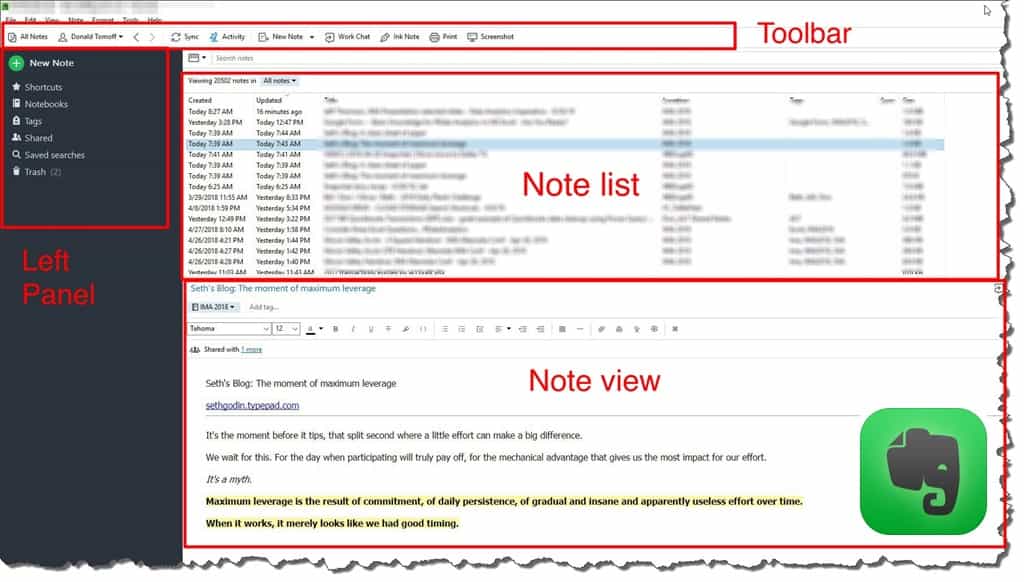
In my book, there is only one clear winner - Evernote. It's everything you will ever need to write a book, a course or anything else for that matter.
Of course, I might be biased as I don't know many other programs of this kind.
Evernote makes it very easy to create module and units for every single folder (i.e. your course idea).
Course-oriented thinking - a long-term perspective
If you have ever dreamt of mastering many fields of expertise, course-oriented thinking should also be right up your alley.
Once you read this article, you can download Evernote right away and start creating course outlines for every single domain that interests you.
Will you be able to pursue them all at the same time with smoldering passion? Definitely not.
Will you be able to work on them for years to come until you achieve mastery? Absolutely.
You can think of every field of expertise you want to master as a journey. Maybe you won't make too many steps in the forthcoming months. But you will keep on going and you will keep on getting better.
What's more, the mere awareness of having a course which you can expand should keep your eyes wide open to all the wonderful facts and information you stumble upon.
They all will become a welcome addition to your creation. And as with learning intensely, the more courses you create, the easier it will be to master any other domain.
Examples of practical, long-term courses

I am pretty sure that you already have a rough idea of which areas of expertise you want to explore. Regardless, I've wanted to show you some examples of the courses I have created so far. Of course, they are work in progress. Knowing me, I will keep on expanding them till the day I die. You might use them as a source of inspiration.
A list of my projects (i.e. courses):
The list is certainly not complete but it should give you a general idea of what to gun for. Remember to think long-term. Your course (i.e. knowledge) doesn't have to be perfect from the get-go. The mere action of having such a project in place will help you put any piece of information in the right context.
Approaching learning in this manner can lead to truly spectacular results. You might discover that after some time, some of your projects will come to life and will become an inseparable part of your existence.
For example, I have never thought of myself as an investor. However, just a couple of weeks upon creating a rough curriculum of my investing course, I dipped my toes in the financial waters. Surprisingly, it turned out that I am really good at it. These days trading is a part of my everyday ritual.
So what do I think? I think you should give it a shot.
A summary
One of the most important factors affecting your ability to remember things is the coherence of your knowledge. Course-oriented thinking can provide you with an excellent framework for structuring your knowledge. What's more, your potential courses can turn into real-life products which might benefit you in the future.
Keep in mind that your projects don't have to be perfect from the very beginning. They will probably suck. Only working on them systematically and methodically can guarantee that they will become world-class products.
Don't treat them dead-serious and don't be too formal. Sprinkle them with silly memes, anecdotes or quotes. Your courses should be a natural extension of your character. Let your personality shine through the quality information. With time, you might be truly surprised how much this approach can change your life.
Done reading? Time to learn!
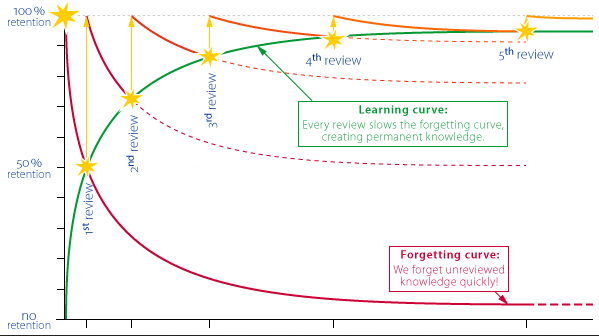
Reading articles online is a great way to expand your knowledge. However, the sad thing is that after barely 1 day, we tend to forget most of the things we have read.
I am on the mission to change it. I have created over 23 flashcards that you can download to truly learn information from this article. It’s enough to download ANKI, and you’re good to go. This way, you will be able to speed up your learning in a more impactful way.