
Master Pronunciation Of A Foreign Language – How To Learn A Language On Your Own (Part 3)

Master Pronunciation Of A Foreign Language

Why even bother with studying pronunciation?

Well, as always, there are no easy answers. Some say it's important to master the pronunciation of a foreign language. Some say it's a waste of time

The question is - why should beginners and semi-advanced learners care?

There are some obvious benefits - the better your pronunciation, the bigger a chance that native speakers will understand you. It means that there is always some minimal amount of work that has to be done in order to talk with native speakers.

Otherwise, each person will soon get discouraged from talking to you and leave or get black-out drunk to match your level of mumbling.

But what comes next after you reach the level, where native speakers have no problems understanding you? Does it make sense to reach for the Holy Grail of learning languages - speaking with no accent?

Considering the amount of time needed, I dare to say no. It's better to spend this time mastering grammar and vocabulary. I have never seen any point in pronouncing everything perfectly while still mixing up words and butchering grammar.

Many people claim to have achieved the level where there is no difference between them and native speakers. I believe that very often this is simply an exaggeration.

Typically, the longer someone talks to a native speaker, the bigger the chance that "the truth gets revealed".

Ultimately, I'll leave that for you to ponder. So what should you do to achieve good pronunciation as quickly as possible?

And to avoid such mistakes:

0. Brief (And Not So Boring) Theoretical Intro


It won't take long, I promise. If you're interested in practical tips, move to point 1.

To speak clearly, we must first understand what the (highly simplified) building blocks of pronunciation are:

  • Phonology - can be seen as "abstract, grammatical characterization of systems of sounds or signs". Which means - what is the difference between sounds. What makes French language French and English English (and Hodor, Hodor, Hodor)
  • Phonetics - deals with "physiological production, acoustic properties, auditory perception, and neurophysiological status" of sounds. Basically, how to produce sounds.
  • Prosody - is the rhythmstress, and intonation of speech. Well, this is kind of self-explanatory.

As you can see, mastering pronunciation requires learning the aforementioned elements of a language of your choice.

Now, how to do it practically...


1. Identify Alien Sounds


As children, we have the ability to distinguish different sounds and "assemble" them into words (in other words, we combine phonemes into morphemes/words).

The sad part about learning new languages is that we mostly lose this ability when we grow up.
It means, that without preparation very often we won't even know that we pronounce something incorrectly.

That's why the first step to get familiar with pronunciation is to identify the sounds which you might even be not aware of.

How to do it


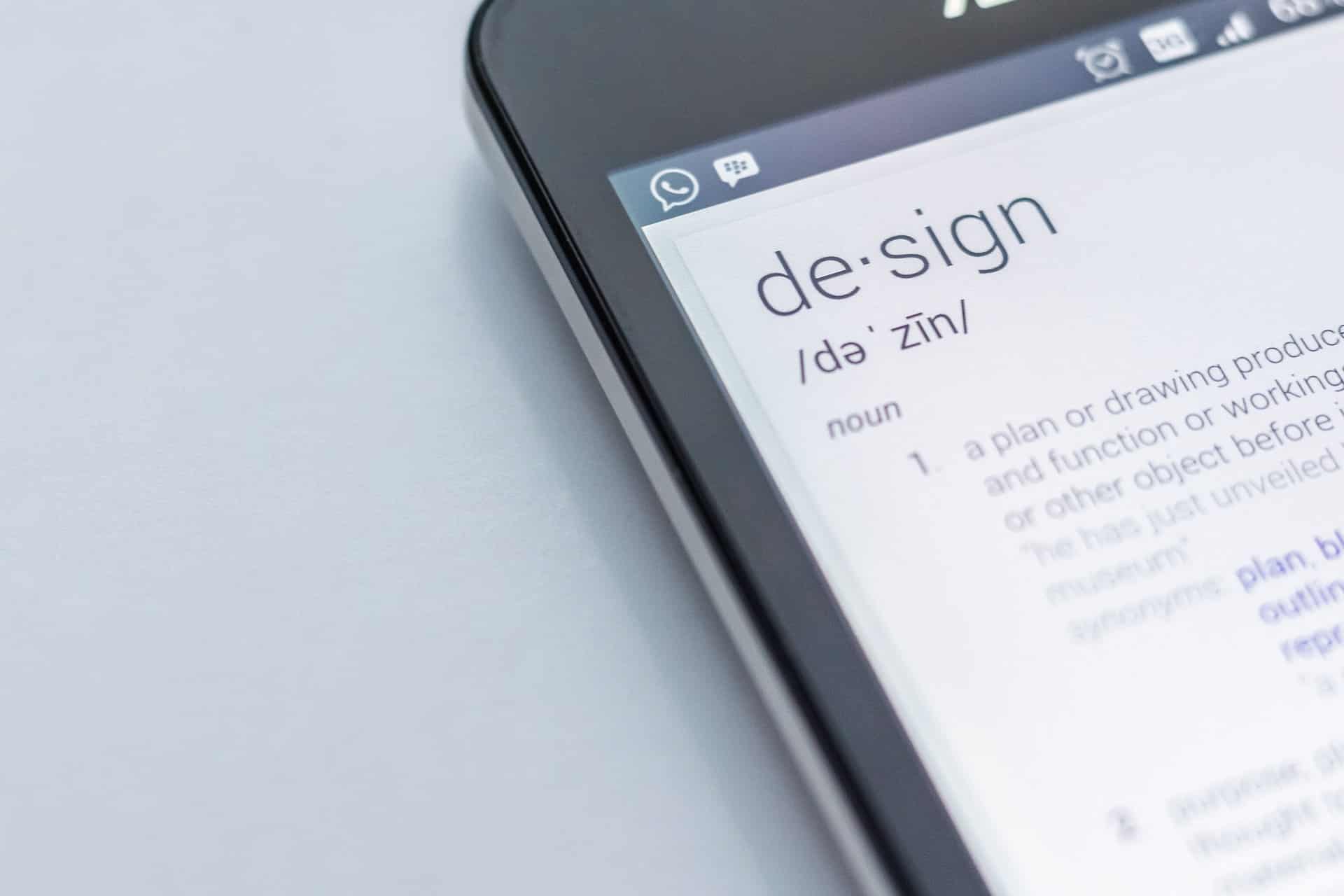
Look it up in a dictionary

Pronunciation Of A Foreign Language


Every good dictionary has a description of sounds typical of the given language. What's more - as I've written before, always try to choose a dictionary which includes phonetic transcription of words.


Google it


" Language x (e.g. Swedish) phonology" will usually deliver best results.


Visit mylanguages.org


It covers 80+ languages. Choose the one you want and click "alphabet".

Now, after using any of these methods, you'll end up looking confused at the strange set of characters. They are part of the International Phonetic Alphabet. They look scary but are not so difficult to learn.

To become even more aware of the differences between your native and target language, you should learn the sounds of English language.

Here you can find an interactive phonetic chart for English.


2. Train Your Mouth To Pronounce Sound


Congratulations, by now you should know more or less, what sounds you should pay attention to. To imitate them as precisely as it's only possible, you need (ideally) combination of a couple of methods.


Learn how to produce sounds mechanically


It's a great starting point - grab a dictionary or some textbook and read a description of how you should pronounce given sounds. If the description is accompanied by a picture - even better.

Usually, the biggest problem is how to pronounce vowels. Since your tongue moves up and down, forward or backward, you have plenty of positions to experiment with.

Once (it seems that) you nail the target sound, try to memorize what the position of your tongue and lips was. And don't be too quick thinking that it is over. You have to check it first. (see feedback)


Start small


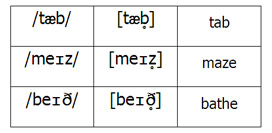
Choose only one or two sounds to begin with. Let's say that you have no idea how to pronounce /æ/.

You check how to produce this sound on Wiki. Then you pick up a word or two and try to pronounce this sound as closely as possible. Say, this word is "tab".
 

Master Pronunciation Of A Foreign Language


Once you are sure that the sound is pronounced decently, you can move on to other words.
Sounds like a lot of work but I assure you it's not.

When I was a child I suffered from a really bad speech impediment and couldn't pronounce a truckload of sounds in my native tongue.

Can you imagine how I talked to my parents or friends?
- "mc wohn sdno"
- "Yes honey, of course, we love you"

I used this method to learn how to express myself like a normal human being.


Record yourself


Find some interesting text, grab a microphone or use your mobile and start reading aloud using the aforementioned rules.

How can you tell if you produce new sounds effectively?

It won't be difficult - assuming that you did everything right, your mouth will hurt.
It means that you use muscles which haven't been used before.

Of course, If you're learning a language with a different alphabet, you should learn how to read it first.


3. Learn How To Hear The Sounds

How To Learn A Language On Your Own


Now, you can start practicing your hearing. You've successfully identified the sounds which are new to you. It's time you started noticing them in sentences!

Such knowledge gives you immediate head-start when it comes to listening to and communicating with foreigners.

Remember, however, that grammar rules concerning your target language might alter your understanding of speech. Some sounds blend, others are silent or reduced.

For example, in French "à" followed by "le" combine to form "au."


4. Be Aware Of Mistakes


It's always safe to assume that you pronounce sounds at least partially incorrectly until you receive some kind of feedback. Such assumption can save you hours and hours of tears and frustration.


5. Feedback


You need final confirmation of how awesome your pronunciation is. And who's better to do it than native speakers?

If you have a tutor or friends who can help you - then great. Ask them all the questions you have and to correct you if there's something wrong.

If you are on your own, try www.rhinospike.com
You can ask native speakers there to record some text for you and then you can use it to compare it with how you speak.

You can also use Google Translate or http://www.forvo.com/ to compare pronunciation of single words. But how will you know that you sound good enough?

You will sound in unison with the recording. Simple as that!


FINAL WORDS


As you can see, learning how to pronounce sounds can be turned into a relatively easy to execute the process. However, as always when it comes to mastering such complex task, the better you try to be, the more time-consuming it is.

And don't beat yourself down, if it doesn't work right away. Good things take time.

A successful man is one who can lay a firm foundation with the bricks others have thrown at him.

If you enjoyed this post, feel free to share it with your friends and join our community!


Done reading? Time to learn!


Reading articles online is a great way to expand your knowledge. However, the sad thing is that after barely 1 day, we tend to forget most of the things we have read

I am on the mission to change it. I have created over 10 flashcards that you can download to truly learn information from this article. It’s enough to download ANKI, and you’re good to go. This way, you will be able to speed up your learning in a more impactful way.


Interleaved Practice – When and How to Use It to Maximize Your Learning Pace

INTERLEAVED PRACTICE – WHEN AND HOW TO USE IT TO MAZIMIZER YOUR LEARNING PACE

We've all heard that practice makes perfect. It takes time and effort to be great at something, and if you want to do it right, you should practice one skill at a time.

For example, a beginning guitarist might rehearse scales before chords. A young tennis player practices the forehand before the backhand.

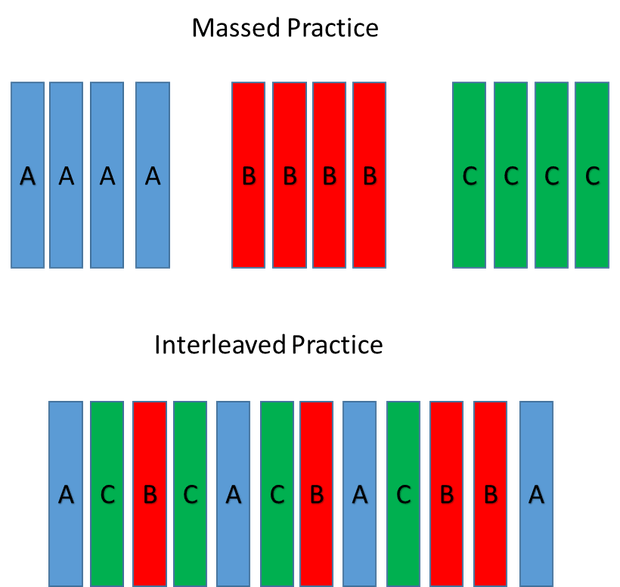
This phenomenon is called “blocking,” and because it appeals to common sense and is easy to schedule, blocking is dominant in schools, training programs, and other settings.

However, the question we should be asking ourselves is this: is blocking the most optimal way to practice skills? It doesn't seem so.


What is interleaving?


Interestingly, there is a much better strategy - enter "interleaving".

 In interleaving one mixes, or interleaves, practice on several related skills togetherIn other words, instead of going AAAAABBBBBCCCCC you do ABCABCABCABC.

It turns out that varying it even slightly can yield massive gains in a short period.

Let's take baseball as an example: Batters who do batting practice with a mix of fastballs, change-ups, and curveballs hit for a higher average. The interleaving is more effective because when you're out there in the wild, you need first to discern what kind of problem you're facing before you can start to find a solution, like a ball coming from a pitcher's hand.

Read more: A Simple Learning Plan To Get The Most Out Of Your Study Time.


Is interleaved practice always the right choice?


There are almost no strategies that are fully universal and can be used for all disciplines and in all learning conditions. The same goes for interleaved practice.

The past four decades definitely demonstrated that interleaving often outperforms blocking for a variety of subjects, but especially motor learning (e.g., sports).  The results for other subjects are mixed.


Studies on interleaved practice in different disciplines


1. Languages

For example, when native English speakers used the strategy to learn an entirely unfamiliar language (i.e., generating English-to-Swahili translations), the results were betterthe same, or worse than after blocking. 


2. Mathematics

Another study  (Rohrer et al., 2015) concerning mathematics showed the dramatic benefits of interleaving on children’s performance at math.

During the experiment, some kids were taught math the traditional way. They got familiar with one mathematical technique in a lesson and then practiced it to death. A second group was given assignments that included questions necessitating the use of different techniques.

The results were as impressive as they were surprising.


One day after the test, the students who’d been utilizing the interleaving method did 25% better. However, when tested a month later, the interleaving method did 76% better.

Keep in mind that such an increase is truly amazing, given that both groups had been learning for the same amount of time. The only difference was that some students learned block by block, and others had their learning mixed up.

Read more: How To Master Many Fields Of Knowledge - Your Action Plan And Recommended Strategies.


The necessary condition before you apply interleaved practice


mazimizer your learning pace

The results above tell us one important thing. You can't just go cowabunga and start interleaving the heck out of every subject.

Before you do so, you should have some familiarity with subject materials (or the materials should be quickly or easily understood).  Otherwise, as appears to be the case for foreign languages, interleaving can sometimes be more confusing than helpful.

It's only logical when you look at this strategy from the memory perspective. For many, using even one technique seems to a burden enough for their working memory. Forcing such people to use three or more make you a psycho who wants to see the world, and their memory, burn.

It's simply too much.

It doesn't take away from the fact that interleaving can be extremely useful. It forces the mind to work harder and to keep searching and reaching for solutions. 

However, if you decide to use it, make sure that you're familiar with the strategies you want to interleave. This recommendation is based on a phenomenon called the expertise reversal.


The expertise reversal

The expertise reversal effect occurs when the instruction that is effective for novice learners is ineffective or even counterproductive for more expert learners.

If you look at it differently, more experienced learners learned more from high variability rather than low variability tasks demonstrating the variability effect. In contrast, less experienced learners learned more from low rather than top variability tasks showing a reverse variability effect.

Why might lower variability be better in the beginning?

It was suggested that more experienced learners had sufficient available working memory capacity to process high variability information. In contrast, less experienced learners were overwhelmed by high variability and learned more using low variability information. Subjective ratings of difficulty supported the assumptions based on cognitive load theory, which you have learned before.

​In other words, some signals that are needed by low prior knowledge learners might be redundant for high prior knowledge learners due to their existing schema in long-term memory (Kalyuga, 2009).

For example, one of the experiments (Likourezos, Kalyuga, Sweller, 2019) which tested 103 adults studying pre-university mathematics, showed no interaction between levels of variability (high vs. low) and levels of instructional guidance (worked examples vs. unguided problem solving). The significant main effect of variability indicated a variability effect regardless of levels of instructional guidance. 

What does it tell us?

We can't play in the big boy's league if we don't cover the basics!

Read more: The Curse of the Hamster Wheel of Knowledge – Why Becoming a Real Expert Is Very Difficult.


Interleaved Practice - Summary

(1) Interleaved practice is perfect for:

  • motor learning
  • any material that can be quickly learned and understood

(2) For more complicated subjects, make sure to familiarize yourself with the appropriate strategies before you decide to interleave them. This way, you will make sure that your working memory isn't overburdened.


Done reading? Time to learn!


Reading articles online is a great way to expand your knowledge. However, the sad thing is that after barely 1 day, we tend to forget most of the things we have read

I am on the mission to change it. I have created over 11 flashcards that you can download to truly learn information from this article. It’s enough to download ANKI, and you’re good to go. This way, you will be able to speed up your learning in a more impactful way.